
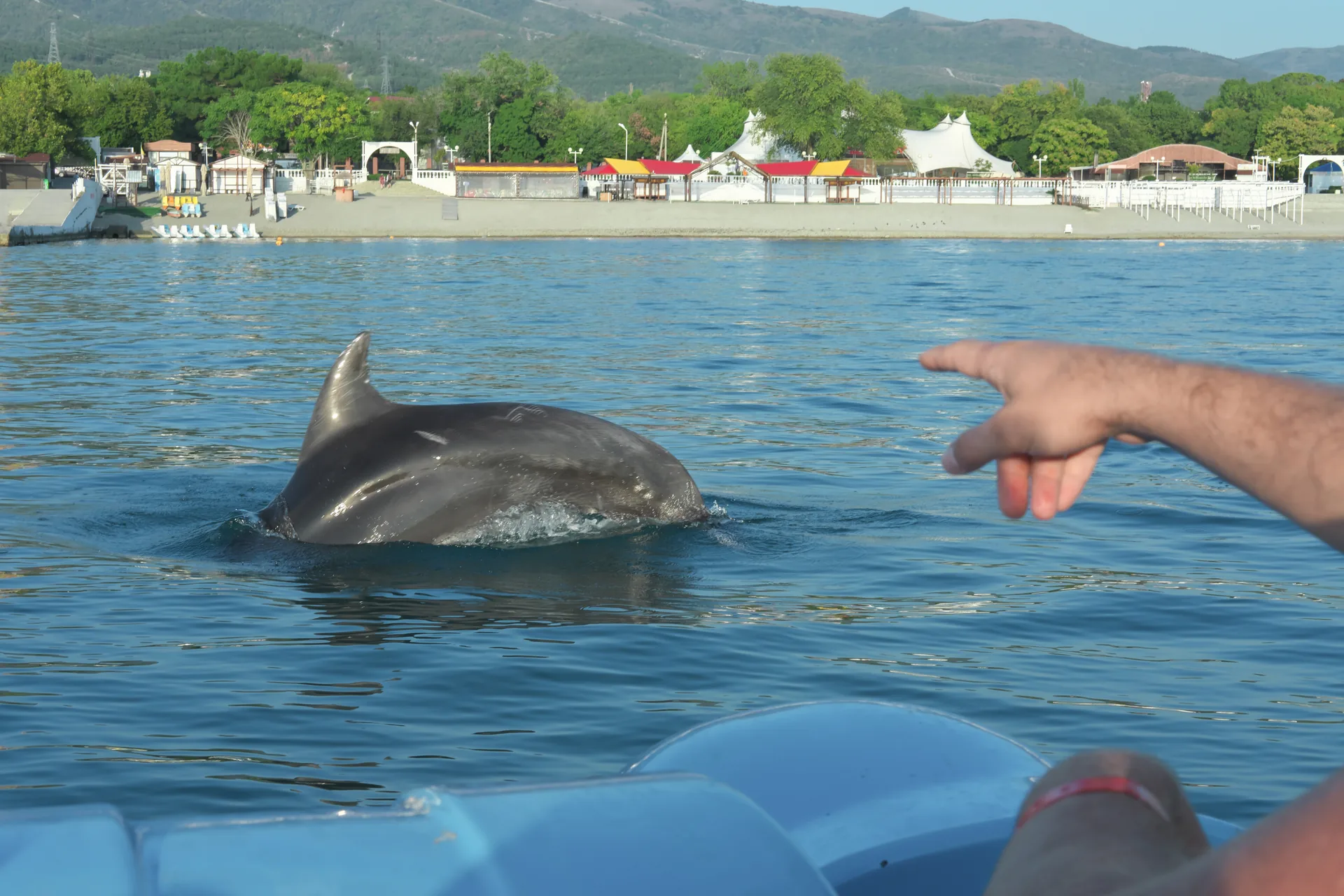
Dolphin encounters in the Gulf of Papagayo are not arranged or scheduled. There’s no feeding station, no predictable show time. What there is are thousands of dolphins distributed throughout the Gulf’s waters year-round — spinner dolphins, bottlenose dolphins, and occasionally pantropical spotted dolphins — behaving exactly as they would if no humans were watching. On most mornings when we’re on the water, we encounter them.
That’s the experience worth describing.
Species in the Gulf of Papagayo
Spinner Dolphins (Stenella longirostris) are the most commonly encountered species in Papagayo. Named for their aerial spinning behavior — full rotations while airborne, multiple times in a single breach — spinners travel in large pods of 20 to several hundred individuals. They’re fast, social, and frequently approach moving boats to bow-ride. Encountering a spinner pod at dawn, while the water is still flat and the spinners are active from a night of feeding, is genuinely something.
Spinner dolphins are predominantly active feeders at night (deep-scattering layer diving for fish and squid in darkness) and rest in shallow, protected waters during the day. The Gulf’s protected interior and the coastline around the Peninsula Papagayo provide resting habitat, which is why spinners are encountered regularly close to the coast in the early morning.
Bottlenose Dolphins (Tursiops truncatus) are the larger, more widely recognized species. Coastal bottlenose in Papagayo are resident — meaning the same individuals live in and around the Gulf year-round rather than migrating seasonally. They’re typically encountered in smaller groups of 5–20 individuals and tend to work specific reef edges and coastal structures where they hunt cooperatively. Bottlenose bow-ride less readily than spinners but are more consistently found in the same areas day after day.
Pantropical Spotted Dolphins (Stenella attenuata) appear offshore, typically associated with tuna schools. The association between spotted dolphins and yellowfin tuna is well-documented in the eastern Pacific — where you see offshore spotted dolphins working the surface, tuna are often directly below them. For anglers, a spotted dolphin aggregation offshore is worth investigating.
When Encounters Are Most Likely
Dolphin encounters in Papagayo happen year-round — it’s one of the advantages of the Gulf’s enclosed, protected marine environment. That said, certain times and conditions produce more reliable encounters:
Early morning (6:00–9:00 AM): Spinner dolphins transition from nighttime offshore feeding to daytime coastal resting during these hours, making them most visible and active at the surface. This window coincides with our standard departure times, which means morning charter guests encounter dolphins regularly without any specific effort.
Calm, flat-water conditions: Dolphins are easier to spot on glass-calm water than on a choppy surface. The dry-season mornings in Papagayo (December–April) typically offer the most reliably flat conditions.
Around bait concentrations: Dolphins and game fish compete for the same food sources. Areas where baitfish are schooling near the surface — visible as nervous water, diving birds, or surface turbulence — often hold both dolphins and predatory fish. For guests on fishing charters, the guide’s search for productive fishing conditions often leads directly to dolphin activity.
What a Dolphin Encounter Actually Looks Like
When our boat intersects a spinner pod at the bow, the experience is close and unmediated. Dolphins ride the pressure wave directly in front of the hull at 1–2 feet depth, visible through the water in full detail. Multiple individuals can be bow-riding simultaneously while others breach in the surrounding water. The encounter typically lasts 5–15 minutes before the pod moves on.
For young children — and for adults who’ve seen dolphins only in aquariums — the proximity and wildness of the encounter makes a genuine impression. These are wild animals choosing to interact with the boat on their own terms.
Whale Encounters
While not dolphins, humpback whales (Megaptera novaeangliae) are regular seasonal visitors to the Gulf of Papagayo. Two separate populations pass through: North Pacific humpbacks in December and January, and South Pacific humpbacks in July and August. Sightings are not guaranteed but are frequent enough to be a realistic expectation during those months — particularly for early-morning charters when whales are most likely to be active at the surface.
Our Relaxation Adventures and Wildlife Tours
The Relaxation Adventures tour is specifically structured around dolphin watching as part of the morning activity — the cruise through the Gulf’s protected waters when spinner dolphins are most active, before anchoring at a beach for the rest of the day. The Costa Rica Wildlife Tour (noon–6:00 PM departure) works the afternoon window with a wildlife focus including dolphins, sea turtles, and manta rays.
That said, almost any morning charter in the Gulf has a reasonable chance of a dolphin encounter as an incidental highlight. We don’t manufacture the experience — but we do know where and when to be on the water for it to happen.
Interested in a tour focused on dolphin watching and wildlife in the Gulf of Papagayo? Get in touch and we’ll build the right morning around what’s active in the water.