
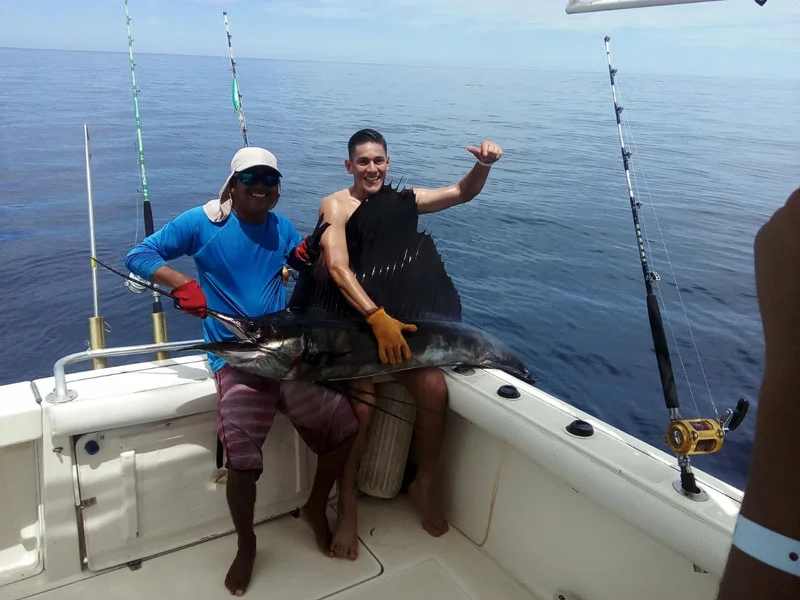
If you’ve been dreaming about catching a billfish in Costa Rica, you’re probably thinking about sailfish or marlin — or both. Most guests arrive with a loose idea that the two are different but aren’t sure how. By the end of a day offshore, the distinction will be very clear.
Here’s what sets them apart and how to think about which one to target.
The Visual Difference
Sailfish have the iconic sail — a massive dorsal fin that runs nearly the full length of their back. When it’s lit up and fanned out (which happens when they’re excited or feeding), it’s one of the most spectacular sights in sport fishing. Pacific sailfish are deep blue-black on top with silver flanks and rows of light spots when they’re fired up. They average 80–120 lbs.
Marlin — blue or black — are heavier, more barrel-chested fish. Their dorsal fin is tall but doesn’t extend the full length of the body the way a sailfish’s does. Blue marlin are a deep cobalt on top fading to silver-white below. They’re significantly larger: most blues hooked in Papagayo weigh 200–400 lbs, and larger fish (500+ lbs) are caught every season.
The Fight
Sailfish are acrobatic first, powerful second. A hooked sail typically goes airborne immediately — greyhounding across the surface in repeated jumps, shaking its bill, trying to throw the hook. The fight is fast, intense, and visually spectacular. Most are landed in 15–30 minutes on appropriate tackle.
Marlin are a different conversation. The initial run is long and powerful. Jumps happen but are less frequent — blues tend to fight deep and heavy, using their bulk to stay down. A 300-lb blue marlin is a serious physical challenge on light tackle and can take 45 minutes to two hours to bring to the boat. Some guests are physically exhausted by the end of a marlin fight. That’s not a warning — it’s part of the experience.
The Numbers Game
In Papagayo during peak season (December through April), sailfish are the more accessible target. Our captains regularly raise 6–15 sailfish in a morning — hookup rates during the best months are exceptional. You might fight three or four fish in a single day.
Marlin days are different. You might spend a morning searching for the right conditions, then get one epic shot. The fish are less numerous but individually more significant. A marlin day is never a slow day — it’s an investment in one of the best possible outcomes.
Which Should You Target?
Book for sailfish if: This is your first billfish trip, you’re fishing with beginners or kids, or you want to maximize action and sheer number of fish encounters.
Book for marlin if: You’ve already caught sailfish and want to step up, you’re an experienced angler looking for the hardest fight in these waters, or checking blue marlin off the list is a serious goal.
Both in one day is possible — and it happens. Our captains target whatever is most active, and a day that starts with sailfish on the troll can easily turn into a marlin encounter by midday when the bait conditions shift.
Whatever you’re after, the captains here have put thousands of guests on billfish. Tell us your goals when you book and we’ll build the right day around them.