
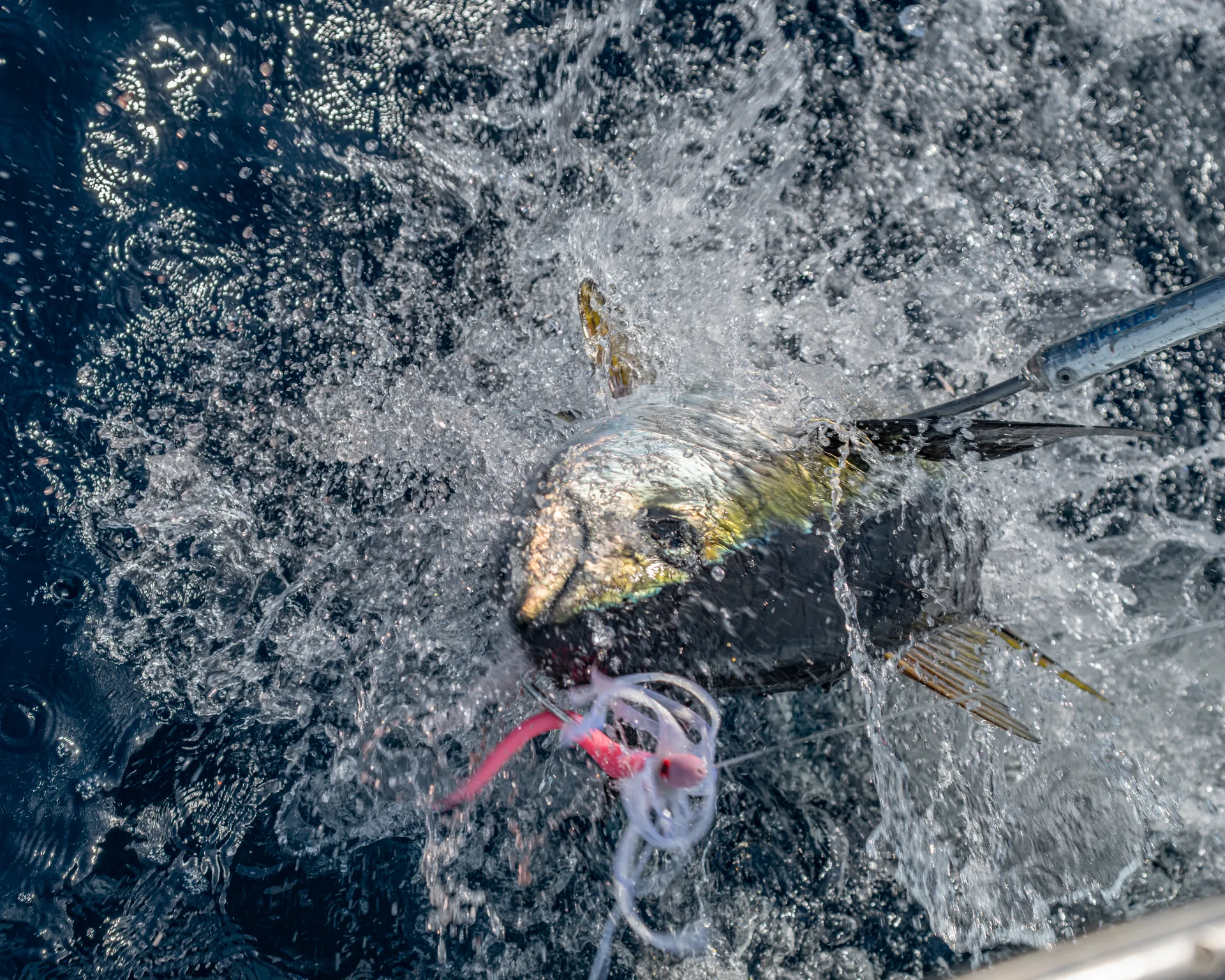
There are fish that look impressive in photos and fish that make you understand why people fly to Costa Rica specifically to catch them. Roosterfish are the second kind. That seven-ray dorsal comb, fanned out as the fish charges a lure in clear shallow water, is one of the most arresting sights in saltwater fishing. And the Gulf of Papagayo is one of the best places in the Pacific to find them.
What Makes Roosterfish Special
Roosterfish (Nematistius pectoralis) are an inshore Pacific species found from Baja California down through Ecuador — but their core range, in terms of abundance and size, runs through Guanacaste and the Gulf of Papagayo. They don’t school like tuna; they hunt in small packs or alone along rocky points, beach breaks, and reef edges in water that’s often startlingly clear.
Most roosterfish landed in Papagayo run 15–40 lbs, with fish over 60 lbs caught several times each season. The IGFA all-tackle world record came from Costa Rica. These aren’t small fish. When one follows a popper across the surface, you can watch the entire strike sequence play out in slow motion — the comb goes up, the water bulges, and then the line goes tight.
Where to Find Them in Papagayo
The rocky headlands and drop-offs along the Papagayo coast concentrate roosterfish year-round. Our captains work specific points and structure that hold fish consistently — the kind of local knowledge that takes years to build and doesn’t appear on any chart.
Key habitat characteristics:
- Rocky points and reef edges — roosterfish use structure to ambush bait
- Moderate depth transitions — the 20–80 foot range is productive for most techniques
- Areas with active bait schools — sardines and mullet near the surface pull roosters into range
- Beach breaks — roosterfish regularly push bait into the shallows along Guanacaste’s pocket beaches
Some of the most consistent spots are only accessible by boat, which is another reason a guided charter dramatically outperforms fishing from shore.
Best Time of Year
Roosterfish are a year-round species in Papagayo, which is one of the things that sets this fishery apart. That said, certain times produce larger fish and more reliable action:
October through April is the traditional peak — calmer seas and the dry-season current patterns push bait schools close to the points, and roosters follow. January and February in particular can produce exceptional inshore action alongside the peak sailfish bite offshore.
May through September (green season) is still productive and often overlooked by visiting anglers. Fish are feeding aggressively, and with fewer boats on the water, the inshore spots see less pressure. Green-season roosterfish tend to run slightly smaller on average, but the volume of encounters can be excellent.
Techniques That Work
Poppers and stickbaits are the most exciting method — watching a roosterfish charge a surface lure is what keeps anglers booking return trips. Cadence matters; our crew knows exactly how to work each bait to trigger strikes.
Live bait under a kite or float is the most consistently effective approach. Sardines and mullet, fished near the surface over structure, are very hard for roosterfish to ignore.
Casting with soft plastics in the 6–9 inch range along rocky structure produces fish when they’re holding tight to the bottom.
Roosterfish on Our Trips
The Half Day Sport Fishing tour specifically targets inshore species — roosterfish, snapper, and tuna — on a focused six-hour session running 10 miles offshore along the Guanacaste coast. Our Full Day charters often combine offshore billfish in the morning with an inshore run in the afternoon, giving you the best of both fisheries in a single day.
If roosterfish are the primary goal, tell our captain when you book. We can structure the day specifically around inshore habitat and the techniques that produce big roosters, rather than splitting time offshore.
Questions about roosterfish or inshore fishing in Papagayo? Get in touch — our captains have spent decades reading the reefs and points of this coastline.